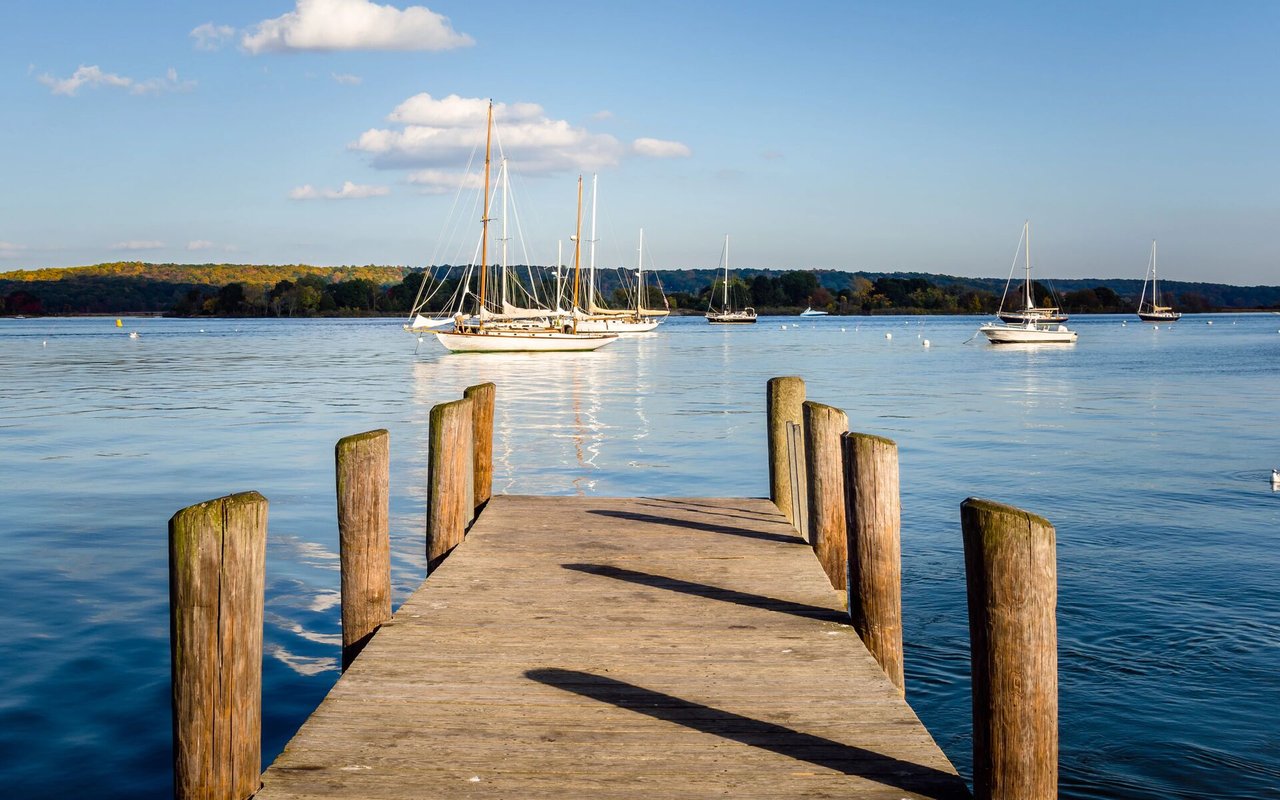
Charles Island Reopened September 9. The Right Season to Walk It Runs Through April.
October 1, 2026
October 1, 2026
A neighbor came back from Silver Sands one Saturday in July, annoyed. She'd walked the boardwalk out toward the sandbar with her kids, hoping to let them run around on Charles Island the way she remembered doing as a kid herself. Instead she found a rope line, a posted sign, and a Connecticut DEEP patrol officer explaining that the island was closed until September. She'd picked the one four-month stretch of the year when the crossing everyone talks about isn't actually open.
That's the part of Charles Island most people get backward. The sandbar connecting Silver Sands State Park to the island exposes itself twice a day at low tide almost year-round, but the island itself only receives visitors from September 9 through the end of April. Connecticut's Department of Energy and Environmental Protection has enforced that exact closure window, May 1 through September 9, every year for well over a decade, protecting nesting snowy egrets, great egrets, glossy ibis, and little blue herons that use the island as a rookery. Summer is when the beach is busiest and the boardwalk is packed. It's also the one season nobody actually gets to set foot on the island.
If you've lived in Milford through a few summers, you already know the rhythm: warm months, full parking lot, kids on the boardwalk, and a rope barring the far end of the sandbar. What's less obvious is how consistent that closure has been. DEEP announced the identical closure, May 1 through September 9, in 2011, 2015, 2016, and 2018, and the current Silver Sands State Park page still lists September 9 as the date the island reopens. It's not a one-off rule. It's an annual clock that resets the same way every spring and lifts the same way every fall.
| Window | Status |
|---|---|
| May 1 – September 9 | Island closed to protect nesting birds |
| September 10 – April 30 | Island open, tide permitting |
Right now, in late September, we're a few weeks into the open half of that calendar. The crossing that was fenced off all summer is walkable again, and it will stay that way until next spring.
Being in the open window doesn't mean any random afternoon works. The sandbar, technically a tombolo, extends about a mile from the mainland to the island according to the park's own fishing guidance, and it's only exposed for a window of roughly two hours bracketing dead low tide. Trail guides recommend the low tide reading come in at minus 0.5 feet or lower before you attempt a round trip, since anything shallower doesn't leave the tombolo dry long enough to get out and back safely. Some visitors plan to start walking about 90 minutes before low tide, which gives enough margin to explore the island and still beat the water back in.
That's a different kind of planning than checking a sunset time or a weather app. It means the actual walkable Charles Island season is a rotating set of windows tucked inside the seven-month open period, not a wide-open invitation to show up whenever.
"The entire island areas are completely closed."
That's the language DEEP has used in closure announcements going back to 2011, and it's echoed on warning signs at the access points today. Fencing, posted signs, and patrols exist because the sandbar looks passable from the beach even when the island itself is off limits, and because the tide covers the crossing fast enough that people have been caught out on it. DEEP looked at closing the sandbar outright after a drowning in 2011 and concluded it wasn't practical, so the fencing and patrol approach is what's stayed in place since.
The island earns its nickname, sometimes called Thrice Cursed Island locally, from a history that reads like a list of things that didn't work out. It was known as Poquehaug to the Paugussett before English settlement in 1639, then Milford Island, then Charles Island after Charles Deal bought it in 1657 and tried, unsuccessfully, to grow tobacco there. Waterbury button manufacturer Elizur Pritchard bought the island in 1852 and built a seventy-five-room resort with a swimming bath and an aquarium billed as one of the largest in the country. That resort closed by 1868, and the island was leased out to run a fish oil and fertilizer operation until the smell got bad enough that the town sued and shut it down in 1884. Decades later, Dominican Fathers ran an Aquinas retreat on the island from 1929 to 1938. None of it lasted, and the ruins from those failed ventures are still visible if you walk the interior today.
The Captain Kidd legend gets attached to all of this too, the story that the pirate buried treasure here in 1699 on his way to Boston, where he was arrested. Historical accounts place the treasure he is documented to have buried at Gardiners Island off Long Island, and no treasure has been found on Charles Island.
The state acquired the island and the surrounding parkland after Hurricane Diane destroyed 75 shoreline homes in 1955, eventually completing land transfers on over 300 parcels by 1960 to create what became the state's fourth shoreline park.
What's changed more recently than any of that history is quieter. After Superstorm Sandy hit the shoreline in 2012, Charles Island's tree cover took a visible hit, and invasive vines and disease finished off a lot of what storms didn't. A group of residents has been working with DEEP since then on the Charles Island Reforestation project, running a Trees4Charles fundraiser that reached its funding goal for tree acquisition, backed by the Devon Rotary Club and Milford Rotary Club. If you cross this fall and see young trees fenced off in deer cages scattered through the interior, that's the reforestation effort at work, not landscaping.
The boardwalk that gets you to the sandbar doesn't start or end at Charles Island. It runs from Silver Sands west to Walnut Beach, Milford's own city beach with a fishing pier at the far end. Along that stretch and just off it, the corridor holds a handful of small, specific businesses worth knowing by name if you're making an afternoon of it: Kinship Glassworks and Artfish42 for anyone who wants a stop that isn't sand and salt air, Scoot & Paddle if you'd rather explore the water than walk around it, and WalkAboutYoga for something calmer before or after the crossing.
If low tide doesn't line up with your afternoon, the Milford Historical Society and the Milford Point Coastal Center, run by the Connecticut Audubon Society, both sit close enough to fold into the same trip. The Coastal Center in particular tends to have programming that actually explains what you're looking at out on those tidal flats, which is worth more than a guess if you've ever wondered what kind of bird you just watched take off from the rocks.
A short list worth keeping in mind if this is the fall you finally make the crossing:
The window closes again next May. Between now and then is the actual season for this place, whatever the beach parking lot looked like back in July.
If you're the kind of person who notices this stuff about Milford, the shifting tide charts, the fenced-off seasons, the small nonprofit quietly replanting a wind-battered island, that's the same attention we bring to the market here. The Hill Team has spent over a decade paying attention to the details that make this shoreline what it is, on the water and in the neighborhoods around it.
Stay up to date on the latest real estate trends.






Choosing the right real estate team makes all the difference. We combine in-depth market knowledge, strategic marketing, skilled negotiation, and personalized service to ensure every client experiences a seamless and successful journey from consultation to closing. Your goals become our mission, and we work relentlessly to exceed expectations at every stage.